- Agent Pulse
- Posts
- GPT-5.5 Crosses the Line From Chat to Execution
GPT-5.5 Crosses the Line From Chat to Execution
Inside the Pentagon’s 100,000-Agent Surge That Signals What Comes Next

O P
April 23, 2026

Sponsored by

PE training trusted by Blackstone.

Wall Street Prep trains analysts inside Blackstone, KKR, and Carlyle. Now they've teamed up with Wharton Online to bring that same program to you over 8 weeks:
Join LIVE office hours with Wharton Business School faculty, to pressure-test your deal assumptions in real time
Earn a Wharton Online certificate in Private Equity (something more defensible than "I'm pretty good at Excel")
Get lifetime access to materials, events, and a network of 5,000+ professionals who are just as obsessed with deal flow as you are
Program starts June 8. Code SAVE300 saves $300 on tuition.
AIonFire | AArena | Submit Agent | Advertise | SEO Backlink
Welcome back! OP here again, helping you with another addition of Agent Pulse - your go-to spot for agentic news, insights and more.
In today’s:
👉 TOP Agentic News
✨ Featured Agents
🎙️ What to Watch this Week
⚔️ Agent Arena Battleboard
🏆 Agents Leaderboard
🗺️ Agents Landscape Map

OpenAI launched GPT-5.5 on April 23 and framed it less as a chat upgrade than as a stronger model for execution-heavy work across coding, computer use, research, data analysis, and document creation. The company explicitly highlighted gains in agentic coding, computer use, knowledge work, and scientific research, which makes this a meaningful substrate update for anyone building or deploying agents. On OpenAI’s published evals, GPT-5.5 posted 82.7% on Terminal-Bench 2.0, 78.7% on OSWorld-Verified, and 84.9% on GDPval, all of which map closely to real agent workflows rather than pure reasoning trivia. OpenAI also said the model is rolling out in ChatGPT and Codex now, with API availability coming soon, which matters because it speeds adoption across both end-user and developer stacks. Strategically, this is another sign that frontier model competition is being judged more by dependable long-horizon task completion than by benchmark theater alone.
Breaking Defense reported that Defense Department personnel are using a Google Gemini tool to create AI agents for handling data and automating online tasks on unclassified networks. The standout number is the report’s reference to 100,000 AI “agents,” which, if sustained, would make this one of the clearest signals yet that agent-building is becoming a mass internal capability rather than a niche expert function. What matters here is not just defense adoption, but the normalization of “vibe-coded” task agents inside a large, process-heavy institution. That points to a broader market direction where agent platforms win by making creation simple enough for non-specialists inside bureaucratic environments. Strategically, it suggests the next phase of agent adoption may be driven as much by internal workforce tooling as by polished external assistants.
[Webinar] Stop babysitting your coding agents

MCPs give your agents access to information, not understanding. The teams pulling ahead are using a context engine to give agents the right context for every task, so they stay on track without the set up tax or the correction loops. Join live on May 6 (FREE) to see how.
Google Cloud and CVC announced a strategic partnership to accelerate AI adoption across CVC portfolio companies in sectors including retail, healthcare, financial services, media, software, telecom, and industrials. The announcement emphasizes Gemini models, Google Cloud’s AI stack, and forward-deployed engineers, which is notable because it ties agentic AI directly to operating-model transformation rather than isolated tooling experiments. Private equity firms increasingly shape enterprise software rollouts across their portfolio companies, so this kind of partnership can act as a force multiplier for agent deployment. Instead of one customer at a time, the model is portfolio-wide operational standardization around agentic systems. Strategically, that makes this less about one partnership and more about PE becoming a distribution channel for enterprise agent infrastructure.
Capgemini said that it is expanding its Google Cloud partnership with a new Google Cloud AI Enterprise Hub focused on enterprise-scale Gemini adoption. The key idea is “Outcome Deployed Engineers,” specialized pods embedded directly inside client environments and working alongside Google’s forward-deployed engineers to build production-ready agents around real workflows. The release specifically calls out in-car agentic experiences, financial-services marketing agents, and retail shopping and food-ordering agents, making the initiative more concrete than generic transformation messaging. This matters because one of the biggest barriers in enterprise agents is not demo quality but the messy translation from model capability to deployed business process. Strategically, Capgemini is betting that the winning services layer in agentic AI will be embedded, workflow-native, and accountable to measurable business outcomes from day one.
Portal26 launched its Agentic Token Control module, pitching it as a first-of-its-kind way to control how much autonomous AI agents consume and spend while they run. The product focuses on real-time token governance, policy-based limits, adaptive safeguards, and operational visibility, with the explicit goal of preventing runaway agent costs and unstable behavior. That is important because as enterprises move from single-turn copilots to multi-step agents, spend volatility becomes an operational risk rather than just a finance annoyance. Cost control is emerging as one of the core layers of agent governance alongside security, observability, and approval flows. Strategically, this shows the agent economy is maturing into a systems-management problem, not just a model-performance race.
Your ads ran overnight. Nobody was watching. Except Viktor.
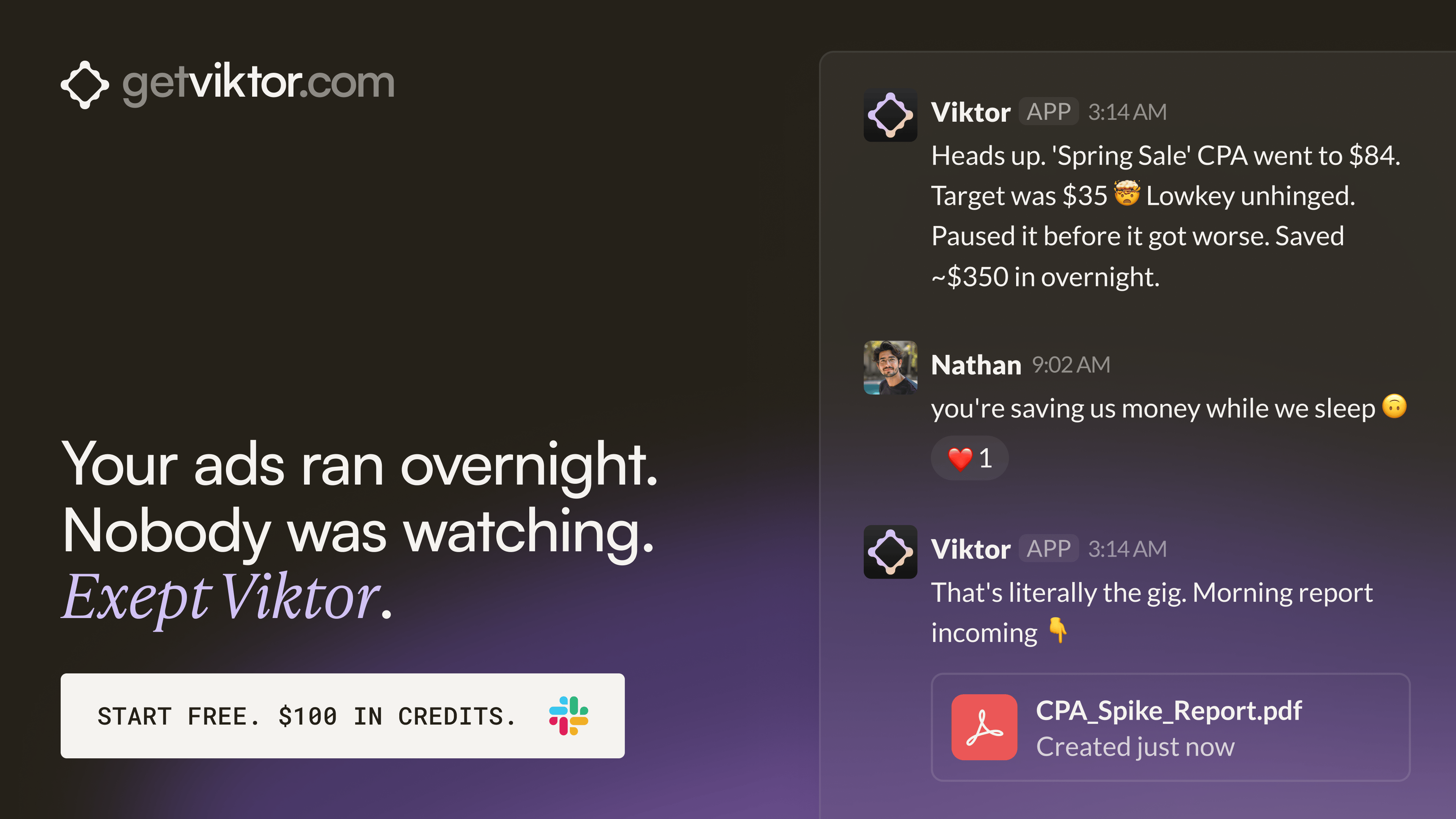
One brand built 30+ landing pages through Viktor without a single developer.
Each page mapped to a specific ad group. All deployed within hours. Viktor wrote the code and shipped every one from a Slack message.
That same team has Viktor monitoring ad accounts across the portfolio and posting performance briefs before the day starts. One colleague. Always on. Across every account.
Featured AI Agents
Skuno - AI platform for retail and warehouse operations in Dynamics 365
GPT Image 2 - Generate, edit, and refine images in one place
GptimgAI - AI image generator for marketing, design, ecommerce
SocialEcho - AI workspace for managing multiple social media platforms
Zawa AI - AI-powered brand kit generator for logos, posters, and mockups
Agentman - AI agents for your entire medical practice back office
Vibe Otter - Build a professional website in just 30 minutes
Handinger - Turn any website into clean Markdown
Nano Banana - Prompt-based photo editing with character consistency
TheLibrarian.io - Your WhatsApp AI sidekick
Blocks - Platform that brings coding agents into your development workflow
Orloj - Declarative agent infrastructure as code for multi-agent AI orchestration

What to Watch this Week
🎙️AI on Fire: Real Builders. Real Heat.
Stories from people building AI Agents. Explore all episodes here
Building with AI Agents? Come talk about it.
AI on Fire is the podcast where we speak with founders and builders shaping the agent economy.
🏆 The Leaderboard Never Sleeps
The global ranking of AI agents is shifting every day. Who’s on top? Who just dropped?
🗺️ The Map of AI Agents (Live & Growing)
We’re charting the entire AI agent ecosystem — thousands of options across categories.
Your next agent is already on the map.


How'd we do? |
Reach 23,000+ Readers:
Newsletter is read by VCs, founders, engineers, managers and tech professionals.
Reply